 Cueword
2nd Grade English Classes: Comprehension, Writing & Speaking
Live one-on-one coaching for Grade 2 in all five skills, built on stories your child picks. This year is about finding the main idea, and telling it back in order.
What We Work On in Grade 2
All five skills, every class.
These are the threads we pull hardest on at this grade.
Finding the Main Idea
Holding on to the main idea of what they hear and read.
Retelling in Order
Retelling a story in the right order: what happened first, next and last.
New Words From the Story
Meeting new words in the story and using them in a sentence.
A Complete Paragraph
Writing a complete paragraph: a story, a fact or an opinion.
What Grade 2 Covers, Term by Term
Grade 2 is about reading to learn, and writing a paragraph.
Each term has six levels, each harder than the last, and ends in a live Showcase in your presence.
Term 1 · Storytelling
Narrative: telling a story well
Six levels, each harder than the last- The main idea of the storySay what a story is mostly about, then retell it
- How stories are builtSee how an opening sets up and an ending closes
- Voices in the storyNotice that characters see things differently
- Details that matterPick the details that matter, in exact words
- Tell it in order, tell it wellRetell in a clear order, most important first
- The story paragraphWrite one connected story paragraph, then improve it
See the five skills this term
- Listening ComprehensionHears a story read aloud and says what it is mostly about, picks out the details that support it, and retells the most important part first.
- Reading ComprehensionSees how a story's opening sets things up and its ending wraps them up, and notices that different characters see things differently.
- SpeakingRetells a story with a beginning, middle and end, adds describing details, tells a moment as another character would, and gives an organized recount at a steady pace.
- WritingBuilds from a few sentences to one connected story paragraph with an opening, details, linking words and an ending, then drafts it and improves it after one suggestion.
- VocabularyWorks out new words from the paragraph around them, and chooses between close words like toss, throw and hurl, or big and huge.
Ends in a Showcase: a story, told live in your presence.
Term 2 · Explaining
Informative: explaining clearly
Six levels, each harder than the last- True stories have big ideasFind the big idea of a true, factual text
- Each paragraph has a jobSee what each paragraph of a text is doing
- Signs and pictures that explainUse headings, captions and pictures to find facts
- How things connectExplain how steps and ideas connect
- Find where it says itPoint to where the text says it, and name its purpose
- The fact paragraphGive a short report, then write a fact paragraph
See the five skills this term
- Listening ComprehensionHears a short factual recording and says its main idea, uses a picture or diagram alongside it, follows the steps in a spoken explanation, and picks out supporting details.
- Reading ComprehensionFinds a true text's main topic and each paragraph's job, uses headings, captions and pictures, connects steps and ideas, answers by pointing to the text, and names the author's purpose.
- SpeakingSays the big idea and one fact, explains steps in order, tells where a fact came from, then gives a mini-report with an opening, a few facts and a close.
- WritingWrites a topic sentence, adds on-topic facts, notes where one came from, and drafts a connected fact paragraph with linking words and a conclusion, then improves it after one suggestion.
- VocabularyLearns words that belong to a topic, checks meanings in a glossary or dictionary, works out words built with -ful, -less, pre- and mis-, and puts new words to use.
Ends in a Showcase: an explainer, presented live in your presence.
Term 3 · Persuading
Opinion: arguing a point
Six levels, each harder than the last- What do you think?State an opinion in a sentence, with one reason
- Find and give reasonsSpot an author's reasons, then give two of their own
- Ask the speakerAsk and answer a question about an opinion
- Two books, one topicCompare two texts on one topic: same, different
- Choose strong wordsChoose more exact words to make a reason land
- My opinion paragraphSpeak, then write, a full opinion paragraph
See the five skills this term
- Listening ComprehensionHears a speaker's opinion and recognizes it as an opinion, picks out their reasons, asks and answers questions about what they said, and follows two recordings on one topic.
- Reading ComprehensionFinds where a character says what they want, sees how reasons support an author's point, compares the main points of two texts on one topic, and spots strong word choices.
- SpeakingStates an opinion in a complete sentence, adds two reasons with because, answers a question about it, then delivers a spoken opinion with an opening, two reasons and a close.
- WritingWrites an opinion with reasons, compares two books using both and but, adds a describing detail, and drafts an opinion paragraph with a conclusion, then improves it after one suggestion.
- VocabularyPicks up opinion words like think, believe, favorite and best, comparing words like both and but, and precise adjectives and adverbs, then uses new words in their own sentences.
Ends in a Showcase: a case, argued live in your presence.
By the end of Grade 2, your child says what a story or a true text is mostly about, uses headings, captions and glossaries to find a fact, answers by pointing to where the text says it, gives an organized spoken report, and writes one connected paragraph: a story, an explanation, or an opinion with reasons.
Placement is a starting point, not a ceiling. Your child moves through at their own pace, so this is the order of the journey, not a fixed timetable.
Gaps From Earlier Grades, Covered
Some children have gaps: a tricky tense, misplaced commas, words they can't spell.
The coach fills them with targeted lessons within your 26 classes a term.
There are no extra classes to book.
Here's what our foundations curriculum covers, up to Grade 2:
Grammar
Common, proper and collective nouns, irregular plurals, pronouns, adjectives and adverbs, past-tense verbs (including irregular ones), and joining simple sentences into compound ones.
Punctuation and Capitals
Commas in letters, apostrophes for belonging and in short forms like can't, exclamation marks, and capital letters for holidays, product names and places.
Spelling
Everyday words like people, water and know, words that share a spelling pattern, and checking a spelling in the dictionary.
Word Building
Prefixes like pre- and dis-, suffixes like -er and -ness, using a root word to work out a meaning, and compound words.
Vocabulary
Working out a new word from clues in the sentence, how words connect, shades of meaning, and putting words in alphabetical order.
Reading and Writing Basics
The beginning, middle and end of a story, characters' voices, a story's lesson, captions and glossaries, and writing a short story, opinion or fact piece.
Plans for Grade 2
Pick the class length that suits your child.
Basic
40-minute classes26 classes · $520 per term (USD)
- Two 1:1 classes a week
- 26 classes over three months
- Same coach all term
- Two parent-coach meetings a term
- Live Showcase and two term reports
Standard
55-minute classes26 classes · $650 per term (USD)
- Two 1:1 classes a week
- 26 classes over three months
- Same coach all term
- Two parent-coach meetings a term
- Live Showcase and two term reports
Questions About Grade 2
What does a Grade 2 class look like?
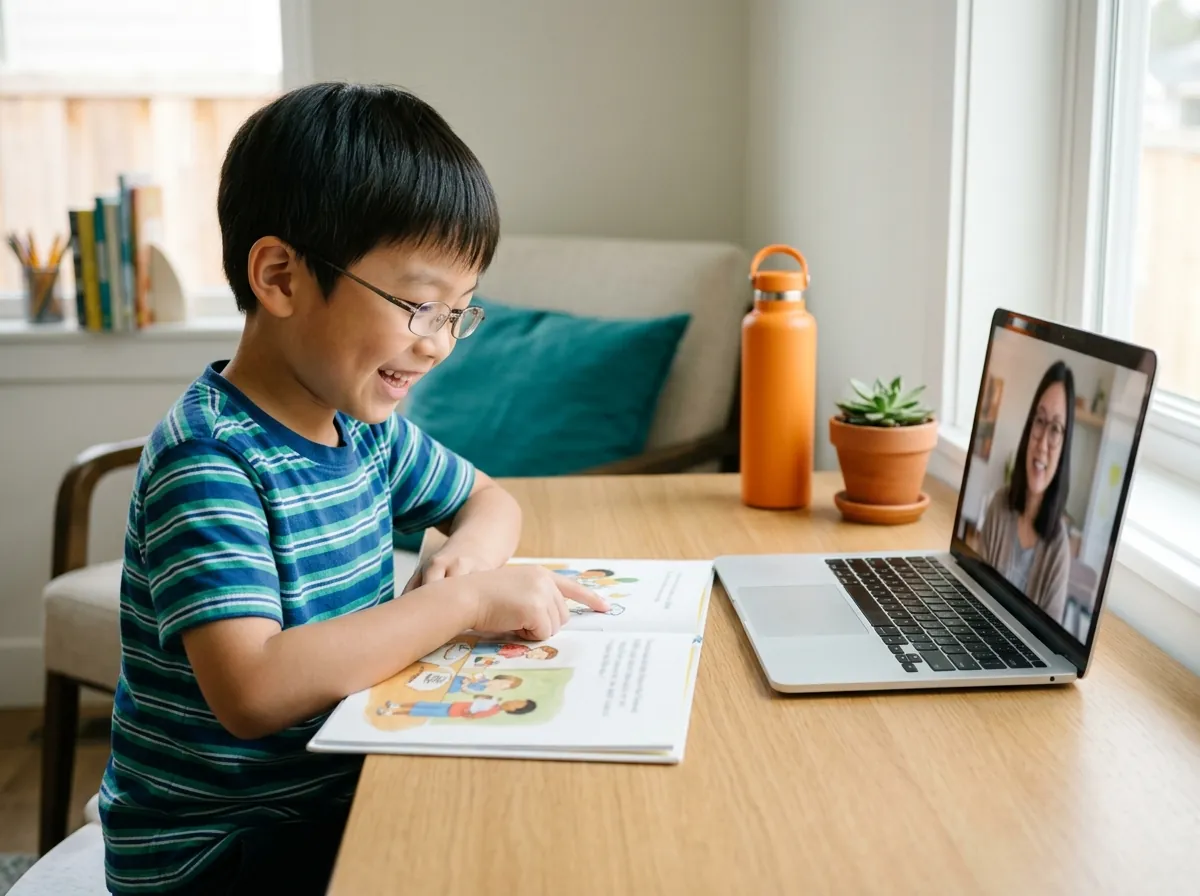
Live, online and one-on-one with the same coach all term. Your child picks the stories they want to do in each class, then listens, reads, learns words in context, speaks and writes about them. The coach follows "Cue, don't tell": they ask the right question so your child works it out.
How long are the classes?
Two classes a week, in terms of about three months. 40 minutes on Basic or 55 minutes on Standard.
How will I see progress?
After every class, the coach sends a class summary in the Cueword Parent app. You also meet the coach twice a term, and get a report after each mid-term and end-of-term assessment. Each term ends in a Showcase in your presence.
How do we get started?
Book a free Cueword evaluation: 50 minutes, one-on-one, a dialogue, not a test. You get the Cueword Report and a recommended plan the same day.
Start Grade 2 With a Free Evaluation
50 minutes, one-on-one, not a test. You get a report and a recommended plan the same day.
Get Started