

Most parents looking for ways to improve their child's English skills at home eventually land on the same three options: hire a tutor, buy a subscription app, or hope the school handles it.
There is a fourth option that costs nothing and takes less time than any of them.
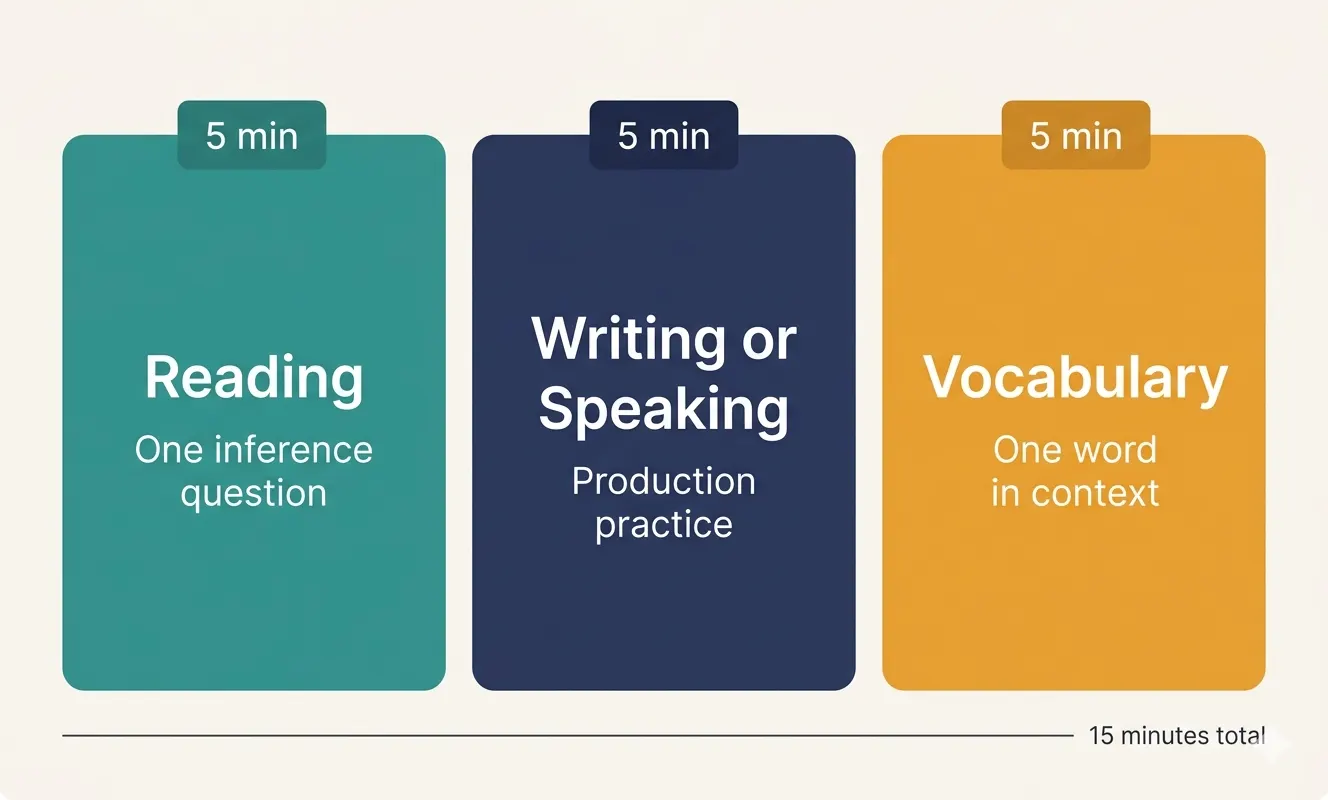
This post lays out a 15-minute evening routine — three components, five minutes each. This routine targets the specific skills most responsible for the gap between a child who reads fluently and a child who writes, speaks, and reasons well in English.
No lesson plan required. No English teaching background needed. If your child is in grades 3 through 10 and you have fifteen minutes on a weekday evening, this is where to start.
The 15-Minute Routine
Three components. Five minutes each. No preparation required beyond asking one question.
The reading can be anything your child is currently reading such as a chapter book, a story, an article. What changes is the question you ask afterward.
Replace "what" questions with "why" questions.
What happened in this chapter? becomes: Why do you think the character made that choice? What in the text told you that?
This slot is about production, getting language out, not taking it in.
For writing: Give your child one sentence and ask them to expand it into 3–5 sentences that make it more specific, without changing what happened. "The room was quiet" or "She opened the door" both work. No more plot. More detail, more precise language.
For speaking: Set a timer for 60 seconds. Give them a topic they know well — for example, a game they play, a book they've read, something that happened at school. The rule: no pausing for more than two seconds. Keep going until the timer ends.
Alternate between writing and speaking across different evenings. Both target the same underlying skill: finding language for meaning, rather than just recognizing it. The "generation effect" — the cognitive science finding that producing language builds far stronger memory than receiving it — explains why passive reading and video-watching alone rarely produce measurable improvement. Something has to come out.
This is the component most parents skip. It's also the one that moves the needle fastest.

Don't drill definitions. Use the last five minutes to introduce one word in context.
Pick a word your child is likely to encounter but doesn't yet own: reluctant, vivid, persistent, subtle. Say it aloud. Use it in a sentence naturally. Ask them to use it in their own sentence — one that sounds natural, not forced.
That's it. No quiz, no flashcard, no worksheet.
Why the Routine Works as a Whole
Each component targets a skill that gets consistently under-practiced in school English classes — not because teachers don't know about it, but because it's genuinely hard to give 25 students individual inference questioning, speaking practice, or contextual vocabulary exposure in a single class period.
The routine works because each evening is a complete, active session — not homework help, not catch-up. The stakes are low. There's nothing to mark. Over four to six weeks of consistent practice, parents typically notice changes in conversation first: children who begin volunteering "why" explanations without being asked, or reaching for more specific words on their own.
When You Want Something More Structured
The routine above is built for parents who want to help without needing to prepare a lesson. If you want sessions that track what your child has practiced, give specific written feedback on their actual responses, and don't require you to be there for every minute, Cueword is built for that.
A Cueword session runs about 10–15 minutes and covers reading, writing, speaking, and vocabulary in a single structured block. The AI feedback doesn't give a score — it gives a specific note on what worked in your child's response, what didn't, and exactly what to try differently next time. It's the natural step up when informal practice has built momentum and you want a structure that continues building on it.
The routine above builds momentum. Cueword gives that momentum a daily structure — with AI feedback on every response, across all five English skills, in a single 10-minute session.
Book a free evaluation →Frequently Asked Questions
Real progress needs a real coach
See where your child's English stands — book a free 50-minute 1:1 evaluation with a Cueword coach.
Book a free evaluation →