 Cueword
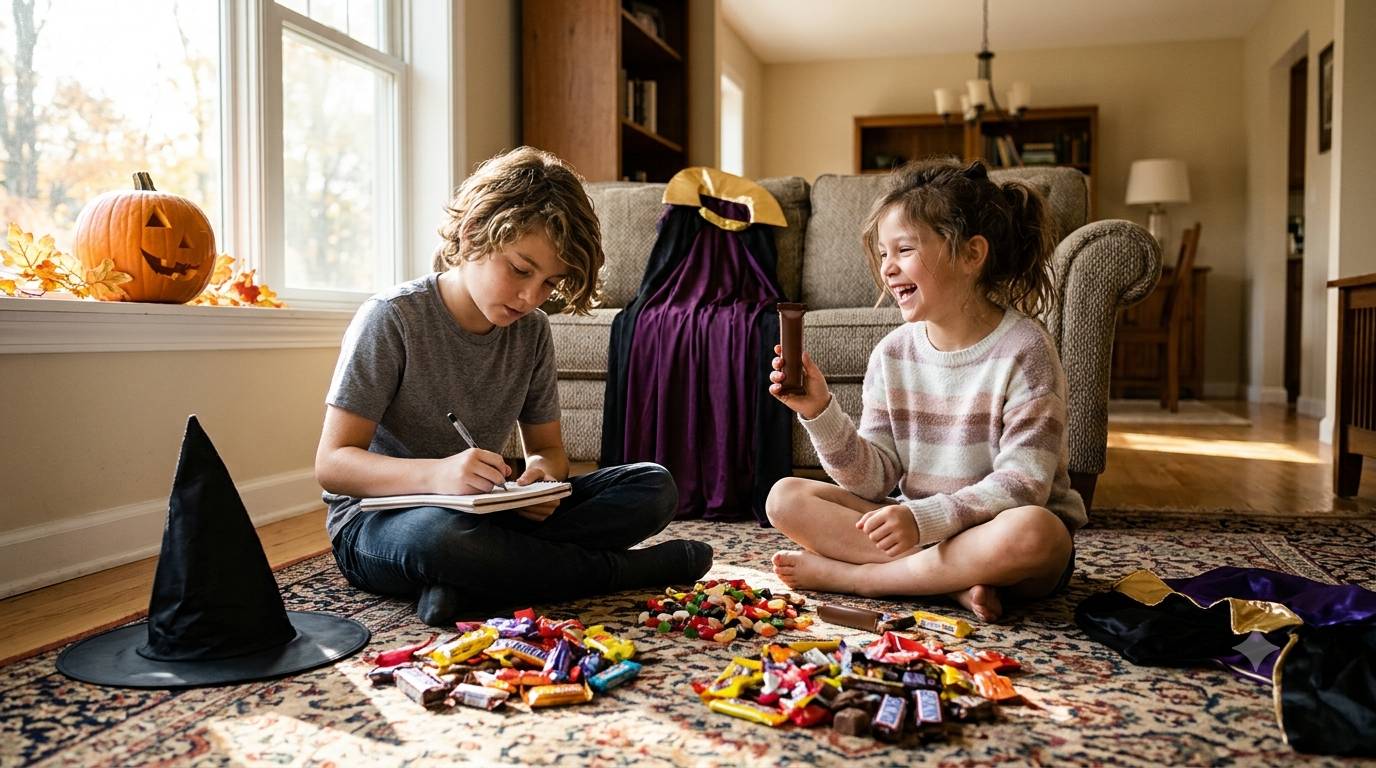
Your child will plan a trick-or-treat route with the care of a military strategist. They will argue, with real evidence, that their costume needs a cape. They will tell the same haunted-house story four times, getting better at the pause before the ending each time. None of that feels like English practice to them. All of it is.
That is what makes Halloween literacy activities so effective: the motivation is already there. You do not need a printable or a worksheet packet. You need to point the excitement your child already has at a few small language tasks, and then get out of the way.
The eight activities below take between five and twenty minutes each. They work for kids in grades 2 through 8, with notes on how to adjust them for older children who think Halloween is "for little kids" and for younger ones who do not love being scared.
Overview
- Why Halloween is a great week for language practice
- Halloween reading activities for kids
- Halloween writing prompts that show how your child thinks
- Speaking and listening: the oldest Halloween tradition
- Halloween vocabulary words that beat "scary"
- Adjusting for a child who does not like spooky
- Frequently asked questions
Why Halloween is a great week for language practice
Most of the year, you are trying to manufacture interest. On Halloween, your child already wants to talk about monsters, invent backstories for costumes, and describe exactly how terrifying the house on the corner is. Psychologists call this situational interest, and it matters: children read more carefully, remember more vocabulary, and write longer when they care about the topic.
Halloween also comes with a built-in genre. Ghost stories have a clear structure (a setting, a build-up, a twist), which makes them perfect for practicing the storytelling skills teachers look for in grades 2 through 8. And because spooky stories are meant to be told out loud, they give quieter children a reason to speak with expression.
Halloween reading activities for kids
Turn off the lights, hand your child a flashlight, and let them read a spooky picture book or chapter to the family. The flashlight does something clever: it gives your child a job and a sense of drama, so reading aloud feels like a performance rather than a test.
Older kids can read a short passage from a classic like The Legend of Sleepy Hollow or a Goosebumps chapter. Afterward, ask one question: "Which sentence made it creepiest?" That single question gets your child rereading for word choice, which is exactly what reading comprehension asks of them at school.
● reading fluency and expression
● attention to an author's word choice
● confidence reading in front of others
Whatever your child dresses as, interview them as that character. "Count Dracula, what do you eat for breakfast? Why do you live in a castle? What are you afraid of?" Your child has to stay in character and answer in full sentences, building a backstory on the spot.
For a twist, interview a character from a book your child has read recently. They will need to remember details from the story to stay consistent, which is inference and recall practice in disguise.
● character understanding and inference
● speaking in complete, connected sentences
● quick thinking
Halloween writing prompts that show how your child thinks
Challenge your child to write a complete scary story in exactly three sentences: one for the setting, one for the build-up, and one for the twist. Some spooky story starters to hand them:
● "The jack-o'-lantern on our porch was smiling, but I hadn't carved it that way."
● "Every house on our street gave out candy except one, and this year its door was open."
● "My costume came with instructions, and rule number one was never take off the mask."
The three-sentence limit forces hard choices. Your child has to pick the one detail that matters and save the surprise for the end. Pay attention to what they do with the third sentence: a child who lands a real twist understands story structure, while one who trails off with "and then they went home" needs more practice with endings.
● story structure (beginning, middle, end)
● concise, purposeful writing
● building suspense
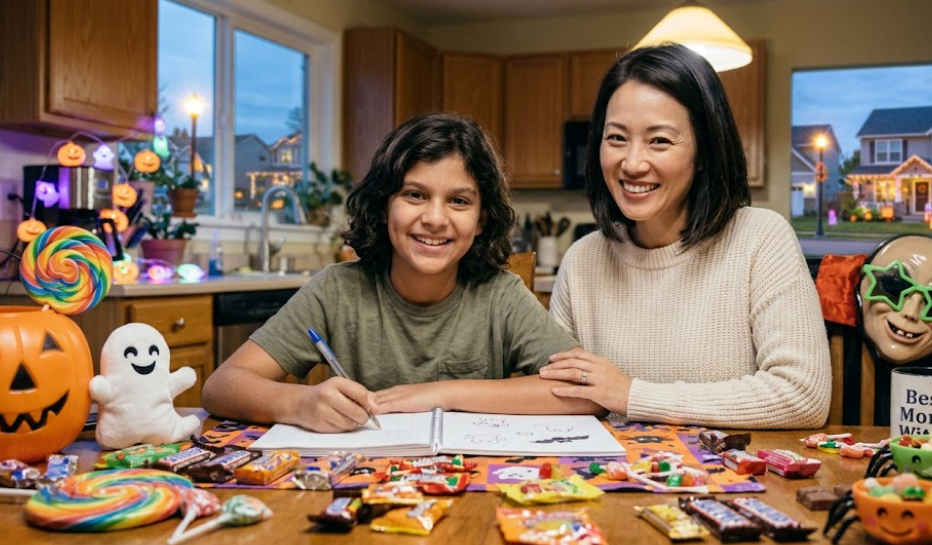
After trick-or-treating, ask your child to write a review of their three best and three worst pieces of candy, with a star rating and at least one reason for each. Reviews are short opinion writing, the same skill schools teach as "persuasive" or "argument" writing from grade 3 onward.
Push for specific reasons. "It's good" earns zero stars. "The caramel sticks to your teeth so the chocolate lasts longer" earns five.
● opinion writing with supporting reasons
● descriptive language
● organizing ideas
Speaking and listening: the oldest Halloween tradition
Long before anyone wrote ghost stories down, people told them around fires. Spoken storytelling is still one of the best ways to practice both speaking and listening at once.
Sit in a circle. One person starts a spooky story with a single sentence. Each person adds one sentence, and every addition must connect to what came before. The rule that makes it work: before adding your sentence, you have to repeat the previous person's sentence in your own words.
That repeat step is listening comprehension practice. Your child cannot drift off while waiting for their turn, because they need to know what just happened.
● active listening
● paraphrasing
● building on someone else's idea
Ask your child to give you a two-minute "tour" of your house as if it were haunted. "On your left is the kitchen, where the refrigerator hums every night at midnight. Nobody knows why." Middle schoolers who are too old for trick-or-treating often love this one, especially if you let them record it on your phone and play it back.
Two minutes of unscripted, organized speaking is harder than it sounds. Your child has to plan a route, keep the story going, and use their voice to hold your attention.
● organized, extended speaking
● using tone and pacing for effect
● descriptive language
Halloween vocabulary words that beat "scary"
Ask your child for every word they know that means "scary." Then line them up from least to most frightening: odd, strange, eerie, creepy, sinister, terrifying, bloodcurdling. Arguing over whether "eerie" is scarier than "creepy" is the point. Kids learn vocabulary best by comparing shades of meaning, not by memorizing definitions.
Try it with other words too: ways to move (creep, lurk, shuffle, slither) or sounds (creak, rattle, moan, shriek). Then challenge your child to use three of the new words in their Three-Sentence Scare.
● shades of meaning
● precise word choice
● vocabulary they will use in writing
Before the candy disappears, have your child sort it by adjectives rather than brand: chewy, crunchy, sour, gooey, fizzy. Every piece needs a category, and every category needs a word. Younger kids practice describing words. Older kids can argue for more precise ones: is a gummy worm "chewy" or "rubbery"?
● descriptive vocabulary
● categorizing and explaining choices
Adjusting for a child who does not like spooky
Not every child enjoys being scared, and none of these Halloween literacy activities require it. Swap the ghost story for a "silly monster" story, where the monster is afraid of something ridiculous. Make the haunted house tour a "mystery tour" instead. The skills are the same: structure, word choice, speaking with expression. Only the flavor changes.
For older kids who roll their eyes at Halloween, lean on irony. Ask them to write a horror movie review of a deeply unscary costume, or to narrate the family's trick-or-treat night as a documentary. Middle schoolers will practice nearly anything if they get to be funny.
If Your Child's Best Ghost Story Deserves a Bigger Audience
If one of these activities lit something up, like a ghost story your child would not stop retelling or a tour guide voice you did not know they had, that is worth noticing. Telling a story well is a skill that can be coached, not just a personality trait.
That is the idea behind Cueword's live 1:1 English communication classes for grades 2 through 8. Each class is built around a story your child chooses from ten per level, and a coach uses that story to work on all five skills: reading comprehension, listening comprehension, speaking, writing, and vocabulary. Coaches follow a method called "Cue, Don't Tell," asking guiding questions so your child does the thinking and talking.
Frequently Asked Questions
Real progress needs a real coach
See where your child's English stands — book a free 50-minute 1:1 evaluation with a Cueword coach.
Get Started →