 Cueword
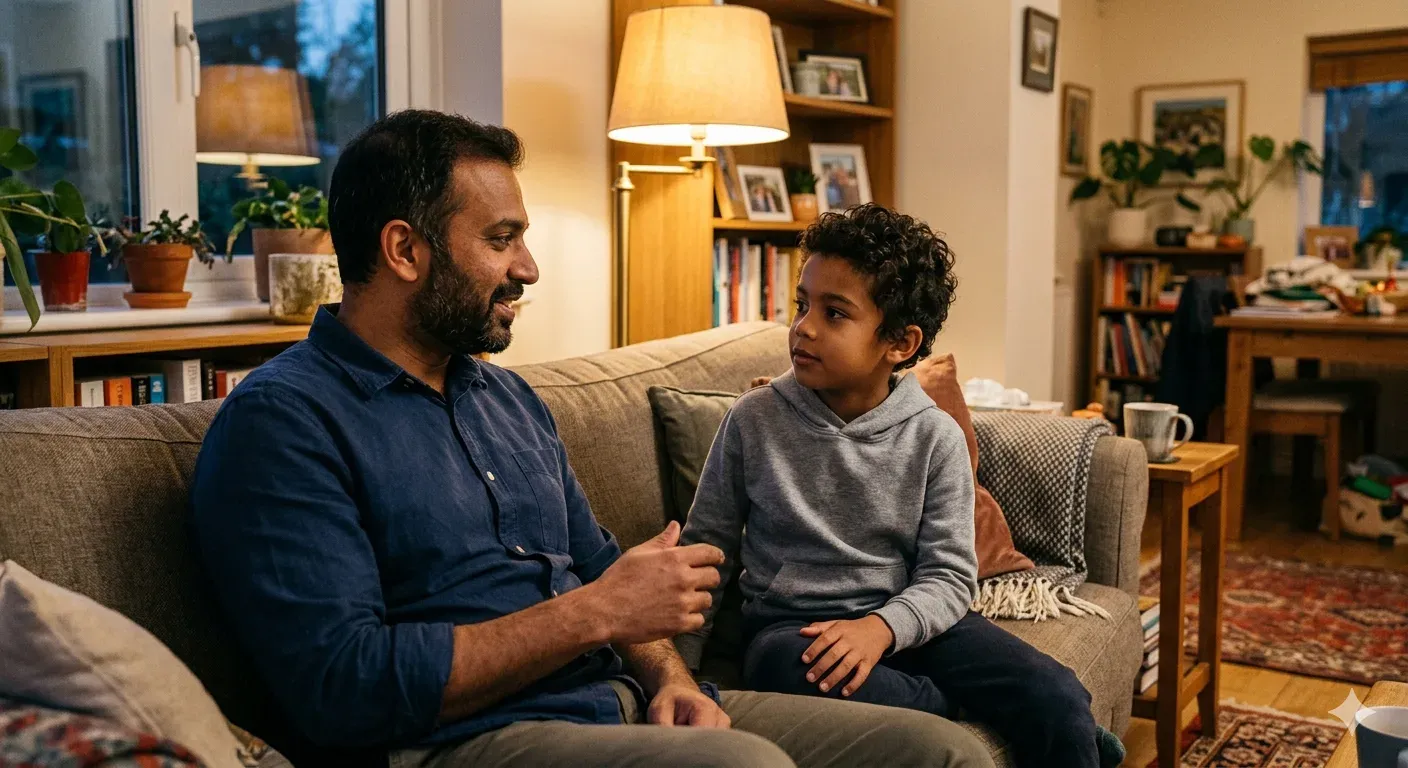
Reading gets the flashcards, the bedtime routine, and the school reading log. Writing gets the homework assignments and the summer journals. Even vocabulary gets its own corner of the fridge with the word-of-the-day magnet.
Listening gets almost nothing. And most listening comprehension activities for kids, if they happen at all, are confined to school.
That's a problem, because listening comprehension is the only one of the five English communication skills that most children encounter on standardized tests without having practiced it deliberately at home. Many state ELA assessments include a listening section. The audio plays once, the questions follow, and the child is expected to recall details, draw inferences, and identify the speaker's purpose from something they heard, not read.
If your child has never done that kind of active listening intentionally, they're encountering a new skill format under test conditions. That's not a vocabulary gap. It's a practice gap, and it's one you can close at home in about ten minutes, without any materials.
Overview
- What makes listening comprehension different from just hearing
- How schools test it and why the format catches kids off guard
- Five listening comprehension activities for kids that take 10 minutes or less
- What strong listening comprehension looks like in practice
- Frequently asked questions
What makes listening comprehension different from just hearing
Hearing is passive. Listening comprehension is the active work of holding spoken language in working memory long enough to process it, organize it, and extract meaning from it.
When your child reads, they can slow down, reread a sentence, and look back at the previous paragraph. When they listen, the words move at the speaker's pace and don't come back. That constraint makes listening comprehension a genuinely distinct cognitive skill from reading comprehension, even though both draw on many of the same underlying abilities.
Research on language listening development identifies working memory load as the central challenge: listeners are simultaneously decoding words, tracking sentences, inferring meaning, and integrating new information with what they heard ten seconds ago. For children in grades 3 through 6, this process is not yet automatic. It takes effort, and effort is trainable.
The practical upside: the same inference-building habits that improve reading comprehension transfer directly to listening. Strengthen one and you nudge the other.
How schools test it and why the format catches kids off guard
ELA assessments typically include a section where a passage or conversation is read aloud (or played as audio) once or twice, the student cannot see the text while listening, and the questions that follow ask about the main idea, supporting details, speaker purpose, or implied meaning. Some assessments add a paired task where students must compare information from the audio to a written passage they read separately.
The format may differ from state to state, but the challenge is the same: your child must listen carefully, process the information in one go and then respond accurately soon after.
Most classroom instruction is heavily text-based. Even when teachers read aloud, students often have the text in front of them at the same time. This builds comprehension, but it does not replicate listening-only conditions. Children who have never practiced listening without a text backup often find the format disorienting, even when the content itself is straightforward.
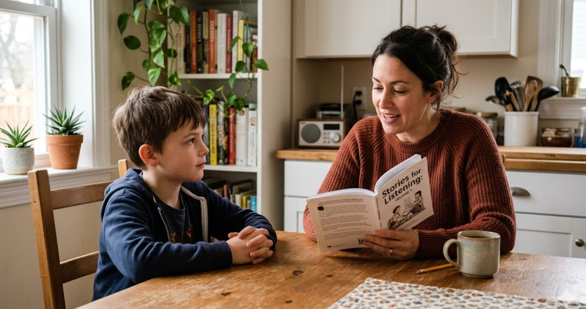
Five listening comprehension activities for kids that take 10 minutes or less
None of these require materials. All take 5 to 10 minutes. They work across grades 2 to 8 with simple adjustments for age.
Read your child a short paragraph (3 to 5 sentences) from any book, article, or age-appropriate non-fiction. Read it at a normal speaking pace, once only. Then ask: "What is the single most important thing from what I just read?"
The one-sentence constraint forces prioritization. Your child has to identify a central idea rather than replay fragments. Once they can do this reliably, raise the bar: "What's the main point and why does it matter?" or "What would you need to remember if this were on a test?"
● working memory capacity for spoken language
● main idea identification
● inference under time pressure
Before you read a passage aloud, share the title or topic only. Ask your child to predict one thing the passage will include. Then read it. Afterward: "Was your prediction right? What in the passage told you?"
The prediction step activates attention before a word is spoken. Instead of passively receiving information, your child is actively listening to confirm or revise an expectation. Reading comprehension researchers call this "active monitoring," and it is disproportionately weak in children who have only been asked to recall what they heard, not to anticipate it.
● active listening stance
● prediction and inference
● comprehension monitoring
Tell your child a short sequence of events or a brief story verbally (4 to 6 sentences). Weave in one specific detail: a name, a number, a color, a location. Two minutes later, ask for that detail casually, without warning.
This trains sustained attention across a full passage rather than just the final sentence heard. Children who struggle with listening comprehension assessments often have strong immediate recall but lose detail from the middle of a passage. This activity targets exactly that pattern.
● sustained attention throughout a passage
● episodic memory for spoken detail
● listening without visual support
Play any short audio clip: a podcast excerpt, a news summary, a short documentary segment. Keep it under 90 seconds. Before you press play, give your child one thing to listen for, such as the main reason the speaker gives. Setting a purpose first turns background audio into active listening. Then play it once, with no pausing and no replay. Ask three questions afterward: one factual ("What did the speaker say about X?"), one inferential ("What did they assume was true?"), and one evaluative ("Do you agree with their point? Why?").
The three-question sequence mirrors the structure of most state listening assessments. The evaluative layer is what separates this from simple recall and makes it genuinely challenging for students across grades.
● multi-level comprehension: recall, inference, and evaluation
● familiarity with spoken argument structure
● the ability to form and defend a position from audio
Read your child a short story or play a one- to two-minute audio clip. Then ask them to retell it into a phone's voice recorder, in their own words and in order, with no notes. Play back the original, then their recording. Ask: "What did you keep? What did you leave out? What did you change?"
Hearing their own retelling next to the original lets your child spot the gaps for themselves, which is far more convincing than being told. Most children are surprised by what slipped through, and they listen harder the next time. Keep the recordings: a retelling from week one next to one from week six is a clear record of progress.
● retelling events in sequence
● noticing what was missed, without being told
● spoken summary and paraphrase
What strong listening comprehension looks like in practice
When listening comprehension is developing, the signs show up in conversation before they show up in test scores. Your child starts asking clarifying questions instead of just nodding. They paraphrase rather than quote. They notice when a speaker contradicts themselves or shifts topic midway. They catch what was implied but not said outright.
These are not signs of a gifted child. They are signs of a practiced one.
When You Want Something More Structured
The five activities above build a strong foundation at home. If you'd like a trained coach working on this with your child every week, that's what Cueword does.
Cueword offers live one-on-one English classes for Grades 2 to 8, on Zoom, with the same coach all term. Each class is built around a story your child chooses and covers five skills, including listening comprehension.
Your child hears a story, then talks through what happened and why. The coach asks questions instead of giving answers, an approach Cueword calls "Cue, Don't Tell." Mid- and end-of-term assessments show how listening is growing alongside the other skills.
Book a free evaluation →Frequently asked questions
Real progress needs a real coach
See where your child's English stands — book a free 50-minute 1:1 evaluation with a Cueword coach.
Get Started →