 Cueword

If you are considering Cueword, you probably have one question before any other: what will your child actually be doing, twice a week, for three months? This walk-through answers it, step by step, from the first free conversation to the moment your child performs a piece in front of you at the end of the term.
The skill that shapes how a child does in school, and well beyond it, is communication: how clearly they think, speak, and write when it counts. That skill grows through conversation, not worksheets. It needs someone to listen, ask the right question, and wait for a real answer. Cueword does exactly this - it uses a live coach, one-on-one, over Zoom.
Here is how Cueword works, start to finish.
- The free evaluation
- Getting matched with a coach
- Inside a live class
- What you see as a parent
- The term arc, ending in a Showcase
- What Cueword is not
- Plans, pricing, and how to start
- Frequently asked questions
The Free Evaluation
Every family starts with a free, 50-minute, one-on-one evaluation for children in grades 2 to 8. It is a "dialogue, not a test," and your child needs no preparation. At least one parent attends, and the session runs in three parts:
- The first 10 minutes: a conversation with you about your child's strengths and goals
- The next 30 minutes: short tasks for your child in listening comprehension, reading comprehension, speaking, and writing (vocabulary is assessed inside the listening and reading tasks)
- The last 10 minutes: the specialist explains what they found
The same day, you get the Cueword Report by email as a PDF: an overall score, a score for each of the five skills, written insights, and a recommended learning plan that places your child at the right level.
Getting Matched with a Coach
Once you enroll, Cueword matches your child with a coach within 72 hours, based on the evaluation and any requests you share. Every coach is a licensed teacher or holds TEFL/TESOL certification, and Cueword says only the top 1% of applicants make it through its screening. Coaches are trained on the Cueword method before their first class, and the training continues while they teach.
Two details matter more than the credentials. Your child keeps the same coach all term, so the coach learns how your child thinks. Cueword calls them coaches, not tutors. The difference shows up in the next step. And if the fit is not right, you can ask for a different coach. No questions asked.
Inside a Live Class
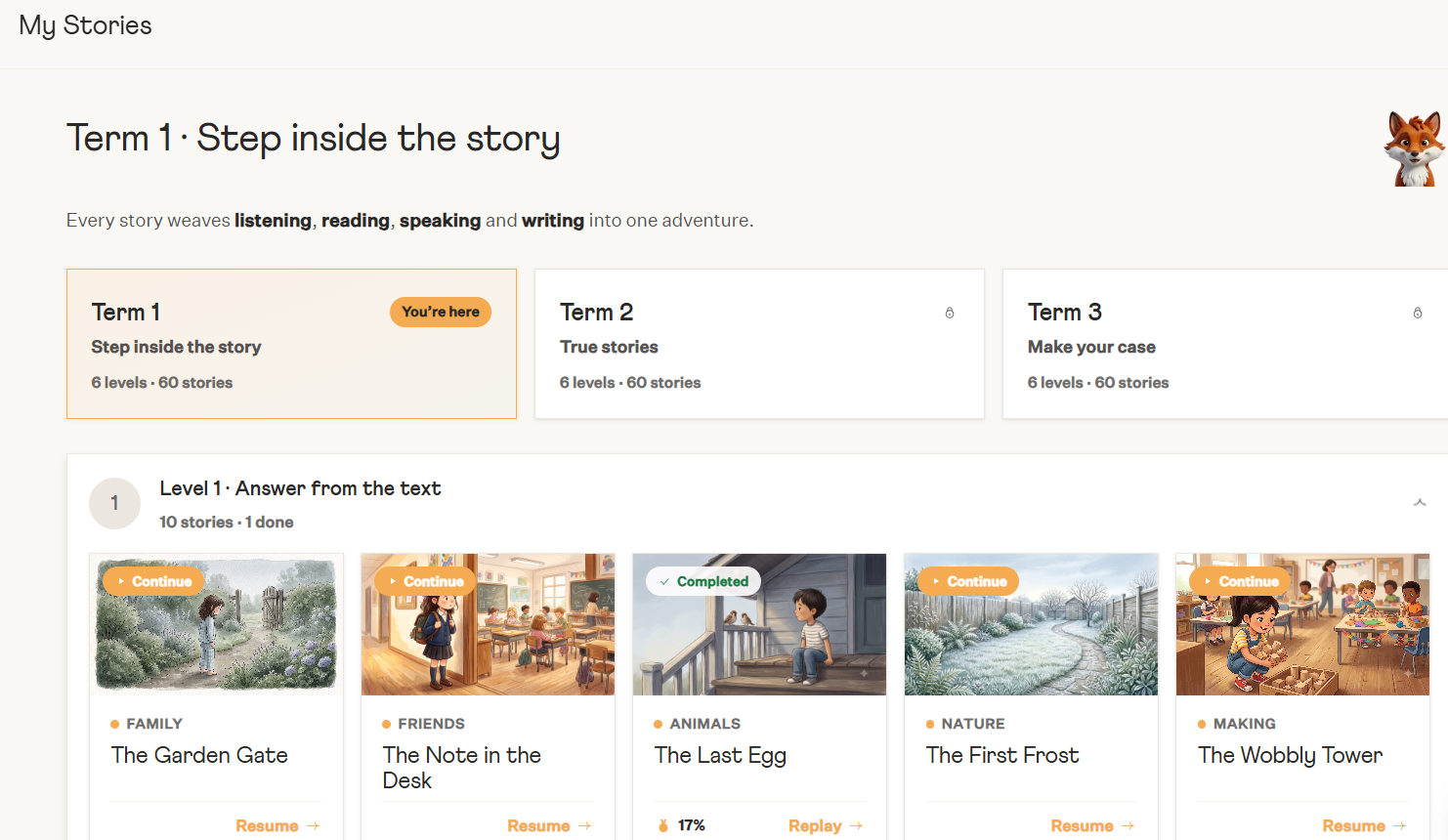
Classes are live and one-on-one, on Zoom with Cueword's own learning platform. There are two a week, either 40 minutes (the Basic plan) or 55 minutes (the Standard plan). Nothing is pre-recorded, and your child is the only student in the class. Every class is built around a story, and your child chooses it: each level has ten, and each level is harder than the last. Through that story, the class covers all five skills:
- Listening comprehension: hearing a passage closely, then talking about what happened and why
- Reading comprehension: reading aloud and finding evidence in the text
- Vocabulary: new words from the story, then used in your child's own sentences
- Speaking: retelling and explaining in full sentences
- Writing: pieces that describe, explain, and persuade
Cueword's teaching method has a name: 'Cue, Don't Tell'. The coach explains, nudges, then steps back, so your child does the thinking and most of the talking.
Here is an illustration of how a vocabulary moment might go:
Notice what the coach never does: define the word. Your child infers the meaning, proves it from the text, then uses it in a sentence of their own. That sequence is why the word sticks.
What You See as a Parent
You do not have to sit in to know what happened, though you are welcome to, and Cueword encourages it. After every class, the coach sends a class summary through the Cueword Parent app. The app is also where you:
- Message your child's coach privately
- See the class schedule in your own time zone, with reminders
- Cancel or move a class (at least 12 hours ahead, or the class counts as used)
- Track progress by level and by skill
Each term also includes two parent-coach meetings, plus a mid-term and an end-of-term assessment, each with a report. If a coach cannot make a class, they tell you in advance, and the class is not charged.
The Term Arc, Ending in a Showcase
A term runs about three months and includes 26 classes. Across a year, three terms build on each other:
- Storytelling
- Explaining
- Persuading (called Arguing for grades 6 to 8)
Each term ends with a Showcase, where your child performs a piece in front of you. It is the clearest progress report there is: you hear, in your child's own voice, what the months of practice has built.

Worried about the Showcase? Read this for quieter kids:
The Honest Version of What Cueword Is Not
Knowing what a program is not built for helps you decide whether it fits.
- Cueword is not homework help. It does not explain tonight's assignment or finish school tasks for your child. It is a communication program that runs alongside school.
- Cueword is not exam prep. The stories, skills, and Showcase are aimed at how your child thinks, speaks, and writes, not at a particular test.
- Cueword is not a substitute for specialist support. If your child has been assessed for dyslexia or another identified reading difficulty, start with the appropriate specialist intervention.
Plans, Pricing, and How to Start
There are two plans, billed per term of 26 classes:
- Basic: 40-minute classes for grades 2 to 5, at $20 per class ($520 per term)
- Standard: 55-minute classes for grades 2 to 8, at $25 per class ($650 per term). Grades 6 to 8 take this plan.
There is no annual lock-in and no hidden fees. You can stop at any time and get a refund for unused classes left in the term, under Cueword's refund policy.
The simplest way to decide is to book the evaluation. Either way, you leave with a report on your child's five skills.
Frequently Asked Questions
Real progress needs a real coach
See where your child's English stands — book a free 50-minute 1:1 evaluation with a Cueword coach.
Get Started →